Have you ever caught yourself writing “I did this, I think that, I feel this” repeatedly in emails, essays, or social media posts? If yes, you’re not alone. In 2026, where digital communication is fast, concise, and engaging, relying on the same word—me or I—can make your writing seem repetitive and dull.
Whether you are a student submitting assignments, a blogger crafting compelling posts, a professional writing emails, or an English learner trying to sound natural, the overuse of “me” can limit expression.
Synonyms not only add variety but also convey tone, formality, and nuance in your message. Using the right alternatives helps you write more confidently, sound more professional, and connect better with your audience.
In this ultimate guide, we’ll explore 25+ synonyms of me, complete with meanings, examples, tone suggestions, and practical tips for modern writing. Say goodbye to repetitive writing and hello to versatile expression!
📖 What Does “Me” Mean?
Simple Meaning:
Me is a pronoun used to refer to oneself as the object of a verb or preposition. It represents the speaker in sentences like “He gave the book to me” or “This worries me.”
Real-World Usage:
- Personal conversations: “Can you help me?”
- Emails: “Please send the details to me.”
- Writing: “It amazes me how fast technology evolves.”
- Social media posts: “This made me so happy!”
Why People Search for Synonyms of “Me”:
- Avoid repetitive writing in digital content.
- Improve tone for formal, casual, or creative contexts.
- Enhance clarity in professional communication.
- Sound more expressive in personal narratives.
- Learn natural alternatives for English fluency.
🧾 25+ Synonyms of “Me” with Meanings, Examples, and Best Use Cases
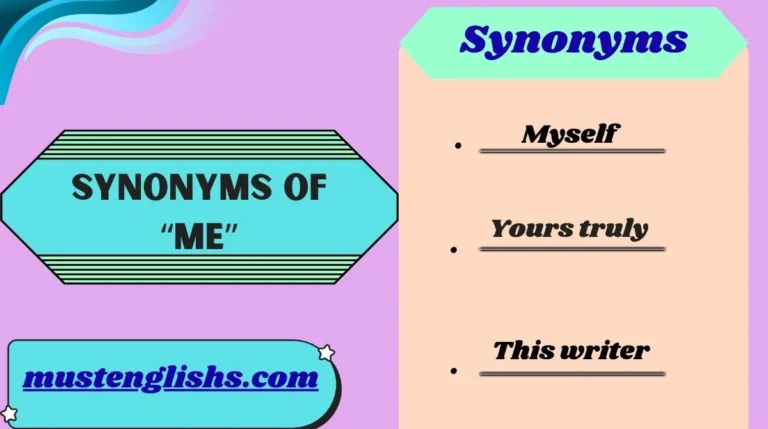
1. Myself
Meaning: Refers to the speaker; emphasizes self
Example: I taught myself to code.
Best Use: Formal writing, reflective statements
2. Yours truly
Meaning: Polite, informal self-reference
Example: Yours truly will handle the project.
Best Use: Letters, emails
3. I
Meaning: Subject pronoun referring to oneself
Example: I enjoy learning new languages.
Best Use: All types of writing, most common alternative
4. This writer
Meaning: Formal self-reference in academic or professional writing
Example: This writer proposes a new approach.
Best Use: Academic papers, reports
5. The undersigned
Meaning: Legal or formal self-reference
Example: The undersigned agrees to the terms.
Best Use: Contracts, formal letters
6. Me personally
Meaning: Emphasizes personal opinion
Example: Me personally, I prefer morning workouts.
Best Use: Blogs, social media
7. Your correspondent
Meaning: Old-fashioned, formal self-reference
Example: Your correspondent attended the event.
Best Use: Journalism, newsletters
8. One
Meaning: Impersonal, formal self-reference
Example: One might consider alternative solutions.
Best Use: Academic writing, philosophical texts
9. The speaker
Meaning: Refers to oneself in presentations or debates
Example: The speaker believes this approach is effective.
Best Use: Public speaking, academic discussion
10. Me here
Meaning: Casual, emphasizes presence
Example: Me here, ready to help anytime!
Best Use: Social media, casual messaging
11. Yours faithfully
Meaning: Polite closing that represents self
Example: Yours faithfully, John Doe
Best Use: Formal correspondence
12. The author
Meaning: Professional self-reference in writing
Example: The author concludes that…
Best Use: Articles, books, research papers
13. The writer in question
Meaning: Formal, slightly indirect self-reference
Example: The writer in question recommends further study.
Best Use: Academic or investigative writing
14. Moi
Meaning: French term for “me”; playful/informal
Example: Moi? I didn’t do it!
Best Use: Informal, humorous writing
15. Myself alone
Meaning: Emphasizes personal involvement or responsibility
Example: I handled the situation myself alone.
Best Use: Narratives, reflective writing
16. This author
Meaning: Formal self-reference, often in academic papers
Example: This author suggests a new methodology.
Best Use: Journals, essays
17. Your humble servant
Meaning: Polite, slightly humorous self-reference
Example: Your humble servant will present the findings.
Best Use: Formal, humorous writing
18. The present writer
Meaning: Formal and clear self-reference
Example: The present writer notes that these trends are rising.
Best Use: Academic writing, formal reports
19. Me, myself, and I
Meaning: Emphasizes oneself in informal speech
Example: It’s just me, myself, and I in this room.
Best Use: Creative writing, blogs, social media
20. This person
Meaning: Neutral, formal or informal self-reference
Example: This person recommends reviewing the plan.
Best Use: Professional, neutral contexts
21. Myself included
Meaning: Expresses personal involvement
Example: Many people, myself included, struggle with deadlines.
Best Use: Essays, speeches
22. Your narrator
Meaning: Storytelling self-reference
Example: Your narrator observed the scene carefully.
Best Use: Creative writing, blogs
23. I alone
Meaning: Emphasizes sole responsibility or action
Example: I alone am responsible for this outcome.
Best Use: Reflective or dramatic writing
24. The present author here
Meaning: Emphasizes current self in formal writing
Example: The present author here argues for change.
Best Use: Academic, formal essays
25. Me, personally
Meaning: Informal, stresses personal viewpoint
Example: Me, personally, I’d choose option B.
Best Use: Blogs, social media, casual conversation
26. Your obedient servant
Meaning: Formal, old-fashioned closing
Example: Your obedient servant, Jane Doe
Best Use: Historical, ceremonial, or humorous use
🧩 Category-Wise Synonym Groups
Synonyms for Business Context:
- The undersigned
- Myself
- The present writer
- I
- This author
Synonyms for Academic Writing:
- This writer
- The author
- One
- The speaker
- The present author
Synonyms for Daily Conversation:
- Me personally
- Me here
- Me, personally
- Myself
- I
Synonyms for Creative Writing:
- Your narrator
- Me, myself, and I
- Moi
- This person
- Myself alone
Synonyms for Professional Communication:
- Yours truly
- Yours faithfully
- Your humble servant
- Your obedient servant
- The present writer here
🎭 Tone Comparison Table
| Formal | Neutral | Casual |
|---|---|---|
| The present writer | I | Me here |
| This author | Myself | Me, personally |
| The undersigned | This person | Me, myself, and I |
| Your correspondent | Me personally | Moi |
| Your humble servant | Myself included | Myself alone |
⚠️ Common Mistakes When Using Synonyms of “Me”
- Using formal synonyms like the undersigned in casual chat—sounds unnatural.
- Overusing playful terms like Moi in professional emails—can be misinterpreted.
- Confusing subject (I) vs object (me) pronouns.
- Repeating informal expressions excessively (me personally)—reduces credibility.
- Using storytelling references (your narrator) in academic writing—context mismatch.
💡 Pro Writing Tips (2026 Style)
- Tailor to Tone & Platform: LinkedIn → This writer, The author; Instagram → Me personally, Me here.
- Edit AI-generated content: Replace repetitive “me” with context-appropriate synonyms.
- Balance clarity & flair: Don’t use overly complex synonyms just to impress; readability matters.
- Use in storytelling: Your narrator, Me, myself, and I add personality to creative writing.
- SEO-friendly variation: Use phrases like “synonyms of me,” “alternate words for me,” and “formal ways to say me” naturally.
⚡ Quick Cheat Sheet Table
| Purpose | Best Synonym |
|---|---|
| Academic Writing | This writer, The author |
| Business Emails | Myself, The present writer |
| Social Media / Blogs | Me personally, Me here |
| Storytelling | Your narrator, Me, myself, and I |
| Formal Letters | Yours truly, Yours faithfully, The undersigned |
| Reflective Writing | Myself included, I alone |
| Creative Writing | Moi, Myself alone, This person |
❓ FAQ Section
What is another word for me?
Alternatives include myself, I, yours truly, this writer, the author, me personally, and more depending on tone.
What is me in simple words?
Me refers to oneself as the object of a verb or preposition in a sentence.
When should you use me?
Use me in sentences where the speaker is the object: “She helped me,” “This worries me.”
Is me formal or casual?
Me is neutral but can lean casual; formal alternatives include this writer, the undersigned, and the author.
How can I avoid repeating me in writing?
Use synonyms like myself, yours truly, the present writer, me personally, or storytelling alternatives like your narrator.
🧠 Did You Know?
- Me is one of the oldest pronouns in English, dating back to Old English.
- Personal pronouns vary widely in tone, from casual (me) to formal (the undersigned).
- Using a variety of self-references improves readability and engagement.
- In digital writing, overusing “I” or “me” can lower perceived professionalism.
- Creative synonyms like Moi or your narrator add humor or narrative flair.
Conclusion
Mastering synonyms of me is more than just avoiding repetition—it’s about shaping your tone, style, and clarity. From academic essays to social media posts, from professional emails to creative storytelling, the right self-reference can elevate your writing instantly.
Now you have 25+ alternatives, categorized by context, tone, and usage. Use them wisely to communicate more effectively in 2026. Don’t settle for the ordinary—choose words that reflect your personality, purpose, and professionalism.
Your writing is your voice—make it versatile, clear, and memorable.