Have you ever written a paragraph and noticed how many times you used the word “to”?
“I want to go to the store to buy something to eat.”
It feels repetitive. Basic. Flat.
In 2026, writing happens everywhere — emails, captions, blog posts, LinkedIn updates, online classes, AI prompts, and business proposals. Clear communication is more important than ever. Small words like “to” may seem harmless, but overusing them can make your sentences sound weak, robotic, or awkward.
Students want better grades. Bloggers want higher SEO rankings. Professionals want polished emails. English learners want smoother sentences. And content creators want natural flow.
That’s why understanding 25+ synonyms of “to” and when to use them can instantly improve your writing.
In this complete guide, you’ll learn practical alternatives, real examples, tone differences, common mistakes, and smart 2026 writing tips.
Let’s refine your language the modern way.
📖 What Does “To” Mean?
The word “to” is one of the most common words in English. It’s a small preposition and particle with many uses.
Simple Meaning
“To” often shows:
- Direction (go to school)
- Purpose (study to learn)
- Movement (walk to the park)
- Time range (10 to 5)
- Relationship (talk to someone)
Real-World Usage
We use “to” in:
- Emails: “I’m writing to inform you…”
- Essays: “The goal is to explain…”
- Conversations: “I want to ask…”
- Social media: “Excited to share…”
- Business communication: “We aim to improve…”
Why People Search for Synonyms of “To”
Even though “to” is essential, writers look for alternatives when:
- Sentences feel repetitive
- Writing sounds too simple
- They want stronger sentence structure
- They need variety for SEO content
- They want more formal tone
Important note:
“To” cannot always be replaced directly. Instead, we often change sentence structure or use different prepositions.
Now let’s explore 25+ practical alternatives and structures.
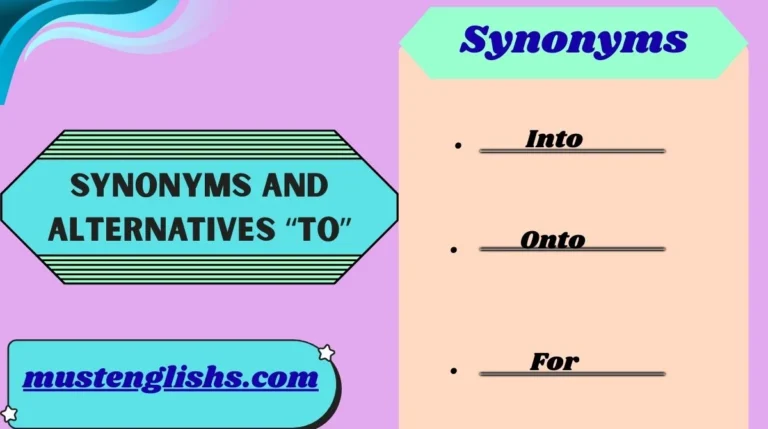
🧾 25+ Synonyms and Alternatives to “To” (With Meanings & Examples)
Since “to” has many functions, these alternatives depend on context.
1. Toward
Meaning: In the direction of
Example: She walked toward the office.
Best Use: Movement or direction
2. Into
Meaning: Moving inside
Example: He stepped into the room.
Best Use: Physical movement
3. Onto
Meaning: Moving on top of something
Example: The cat jumped onto the table.
Best Use: Physical action
4. For
Meaning: Purpose or benefit
Example: She studies for success.
Best Use: Showing purpose
5. In Order To
Meaning: For the purpose of
Example: He works hard in order to grow.
Best Use: Formal writing
6. So That
Meaning: To achieve a result
Example: Speak clearly so that everyone understands.
Best Use: Academic and professional
7. Regarding
Meaning: About
Example: I’m writing regarding your request.
Best Use: Formal emails
8. Concerning
Meaning: About
Example: We discussed concerns concerning the project.
Best Use: Business communication
9. About
Meaning: Related to
Example: Let’s talk about the plan.
Best Use: Everyday conversation
10. Toward
Meaning: In relation to
Example: She has a positive attitude toward change.
Best Use: Opinions and emotions
11. Through
Meaning: By means of
Example: Success comes through effort.
Best Use: Explanatory writing
12. Via
Meaning: By way of
Example: Send the file via email.
Best Use: Professional writing
13. With
Meaning: Accompanied by
Example: She spoke with confidence.
Best Use: Descriptive writing
14. Until
Meaning: Up to a time
Example: Wait until tomorrow.
Best Use: Time expressions
15. Up To
Meaning: Maximum limit
Example: The discount is up to 50%.
Best Use: Marketing content
16. Per
Meaning: For each
Example: We charge $10 per hour.
Best Use: Business writing
17. As For
Meaning: Regarding
Example: As for the deadline, it remains the same.
Best Use: Semi-formal writing
18. In Relation To
Meaning: Connected with
Example: The policy changed in relation to safety laws.
Best Use: Academic writing
19. With Respect To
Meaning: About
Example: With respect to your concern, we agree.
Best Use: Formal communication
20. Aimed At
Meaning: Intended for
Example: This course is aimed at beginners.
Best Use: Marketing and education
21. Designed For
Meaning: Created for
Example: The tool is designed for creators.
Best Use: Product descriptions
22. Meant For
Meaning: Intended for
Example: This message is meant for subscribers.
Best Use: Informal and marketing
23. Bound For
Meaning: Heading to
Example: The train is bound for London.
Best Use: Travel context
24. Due To
Meaning: Because of
Example: The delay was due to traffic.
Best Use: Formal explanation
25. Because Of
Meaning: As a result of
Example: The event was canceled because of rain.
Best Use: Casual writing
26. Instead Of
Meaning: In place of
Example: Use email instead of calling.
Best Use: Comparisons
🧩 Category-Wise Synonym Groups
Synonyms for Business Context
- Regarding
- Concerning
- Via
- Per
- With respect to
- In relation to
Synonyms for Academic Writing
- In order to
- So that
- In relation to
- Due to
- Through
Synonyms for Daily Conversation
- About
- Because of
- Instead of
- With
- Until
Synonyms for Creative Writing
- Toward
- Into
- Onto
- Through
- Bound for
Synonyms for Professional Communication
- Regarding
- Concerning
- With respect to
- Designed for
- Aimed at
🎭 Tone Comparison Table
| Formal | Neutral | Casual |
|---|---|---|
| With respect to | About | Because of |
| In relation to | Regarding | Instead of |
| Concerning | Toward | With |
| Per | Through | Until |
| In order to | So that | Meant for |
⚠️ Common Mistakes When Replacing “To”
- Replacing “to” when it cannot be replaced.
Example: “I want to learn.”
You cannot replace that “to” easily without changing structure. - Confusing “due to” and “because of.”
Both show cause, but “due to” is more formal. - Overusing “in order to.”
It can sound too formal in casual writing. - Using “regarding” in friendly conversation.
It may sound stiff. - Mixing direction words incorrectly.
“Into” means inside.
“Onto” means on top.
💡 Pro Writing Tips (2026 Style)
1. Rewrite, Don’t Just Replace
Instead of replacing “to,” restructure:
- “I went to buy food.”
- “I went for food.”
2. Use Active Voice
Modern writing in 2026 prefers clarity:
Weak: “The goal is to improve results.”
Stronger: “Our goal: better results.”
3. AI Writing Tip
AI tools repeat “to” often. Always edit for variety.
4. Keep It Natural
Simple words work best in digital communication.
5. Improve SEO Flow
Search engines prefer readable content. Sentence variety improves engagement.
⚡ Quick Cheat Sheet Table
| Purpose | Best Alternative |
|---|---|
| Direction | Toward |
| Purpose (formal) | In order to |
| Cause | Because of |
| Business email | Regarding |
| Academic essay | In relation to |
| Marketing | Designed for |
| Casual talk | About |
| Replacement | Instead of |
❓ FAQ Section
What is another word for “to”?
It depends on context. Alternatives include toward, for, regarding, concerning, in order to, and about.
What is “to” in simple words?
“To” is a word that shows direction, purpose, or connection between ideas.
When should you replace “to”?
Replace it when sentences feel repetitive or when a more specific word improves clarity.
Is “to” formal or casual?
“To” is neutral and used in all forms of English.
Can “to” always be replaced?
No. Sometimes you must rewrite the sentence instead of directly replacing it.
🧠 Did You Know?
- “To” is among the top 5 most used words in English.
- Prepositions create sentence flow and meaning.
- Overusing small words can weaken writing rhythm.
- Professional writers revise sentences multiple times for structure.
- Modern SEO values readability more than complex vocabulary.
Conclusion:
“To” is small but powerful.
Still, repeating it too often can make writing feel basic and repetitive.
Now you know 25+ synonyms and alternatives to “to,” how to use them correctly, and when to keep your sentence simple.
Strong writing in 2026 is about clarity, tone, and variety.
Whether you’re a student, blogger, professional, or English learner smart word choice makes your message clearer and more confident.
Don’t just write.
Write with intention.